

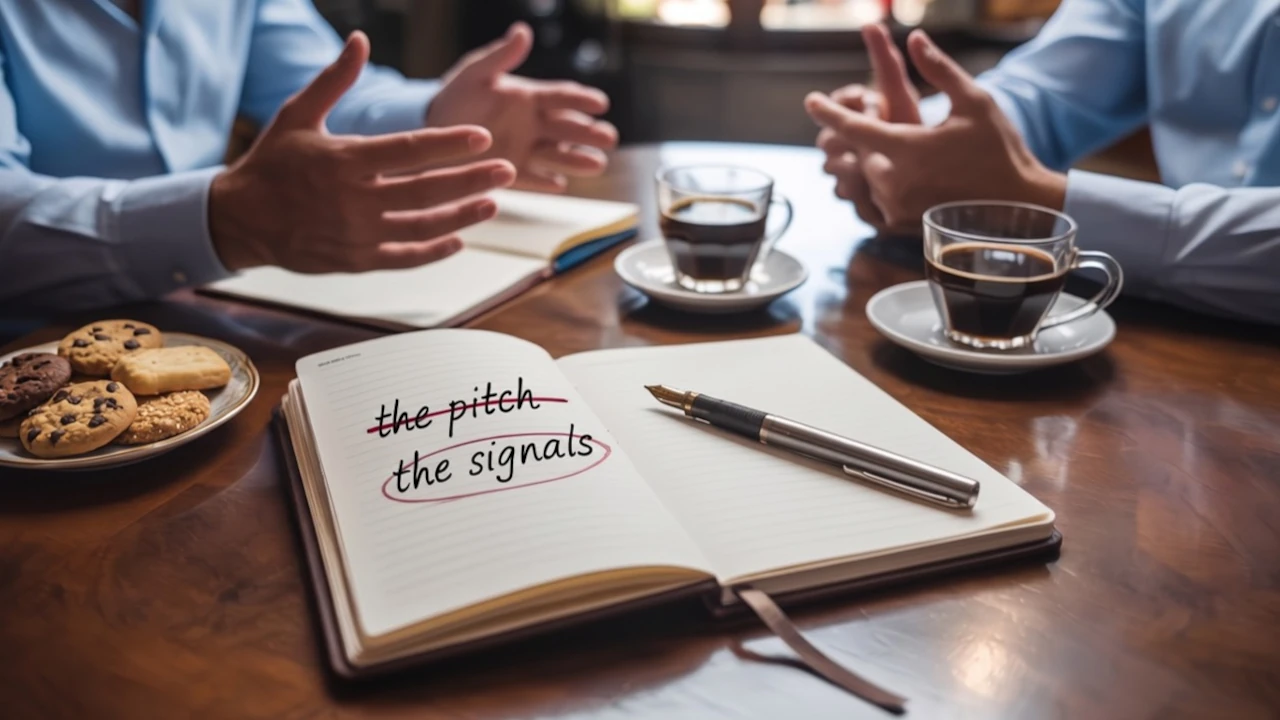
I was 4 minutes into a first meeting, when the man across the table from me said one word, and it made my mind up about him.
Most founders walk into a first meeting listening to a perfect pitch, a polished figure and a track record being laid out across the table like a deck of cards.
But across my 30-year founder journey I’ve learnt to listen for something else entirely.
Discovering 3 signals that are almost invisible, words and gestures that slip out in the first few minutes of meeting someone, that set off alarm bells.
Signals that appear before anyone’s had a chance to settle into who they want to show up as in the meeting.
In those unguarded moments the person across from me tells me almost everything I need to know about them, often without realising they’ve said anything at all.
Here’s the very 1st signal I look for, and the one I apply to my own life all the time.
I listen for how somebody refers to the people they lead – not their ironclad strategy or how big their numbers are – the people who follow them.
I steer the conversation: I first ask how the work gets done, then I ask about the people doing the work, and then I stop talking. We’re waiting to hear one of 2 words.
“Staff”, or “team”.
The words sound small and insignificant; they’re anything but.
“My staff” tells me I’m sitting across from somebody who sees the people around them as instruments. They’re hired to perform a function and are replaceable if they don’t.
“My team” tells me I’m sitting across from somebody who sees those same people as a tribe. They’re in it together, shoulder to shoulder, building something shared.
One word can reveal two
-
entirely different leaders,
-
entirely different cultures,
-
and entirely different approaches
the day the pressure lands and the wheels start coming off.
I’ve yet to meet a “my staff” leader whose business I want to bet on for the long haul, and I’ve yet to meet a genuine “my team” leader who didn’t eventually build something worth being part of.
His was “my staff”.
For most of my 30-year founder journey I would have missed this signal, because I was reading people off of their track record instead of their way of thinking.
The 2nd signal doesn’t hand itself over as easily as the 1st does. We have to go digging for it. And digging means making the room slightly uncomfortable.
All you need to do is ask “why”, then ask “why” about the answer they just gave, and keep asking “why” until you can reach the bottom of their knowledge pool.
The process usually takes about 3 or 4 questions (more than that and they think you’re pulling the mickey out of them).
You’re listening for a sentence, and the sentence is “I don’t know.”
The man who owns what he doesn’t know says it flat, looks at you while he says it, and then tells you how he’d go and find out.
The man who can’t say “I don’t know” reaches for something else instead:
-
a number they try and come up with from skewed calculations,
-
a thingmabob their people are working on,
-
or they laugh awkwardly and steer the conversation in another direction.
You should also listen for a question. Not a question he’s already answered in his own head before asking it, and not one he’s laying down on the table so that he can pick it up again later.
A question he genuinely wants an answer to, from you, because you might have the answer and he might not.
That’s the difference between someone who has humility in what they don’t know and seeks the answer out of pure curiosity vs someone who’s ego is larger than their desire for your partnership.
For the 3rd and final signal you don’t need to have a conversation at all, and you can spot it in about 10 seconds.
Imagine yourself at dinner with a potential supplier. They’re the best in their industry, and you’ve booked the table to work out whether they’d be a good fit for you.
They arrive on time with a younger colleague along to take notes, the 3 of you hand your coats to the woman at the door, and you’re shown to a table at the back.
It goes well. They’re generous with you, funny in the right places, and an hour in they give you the best answer they’ll give all night.
Watch what happens to their voice while they’re giving it – the waiter arrives in the middle of their answer, at the worst possible moment.
Watch whether their tone drops half a step. Whether their words come out flat and fast. Whether their eyes stay on you or acknowledge the waiter. And the second the waiter turns away, whether their warmth switches straight back on.
That switch is the signal you’re looking for. You’re not watching for rudeness, what you’re watching for is someone speaking in 2 different voices and choosing which one you get.
Neither
-
the waiter who interrupted the answer,
-
the woman who took your coat at the door,
-
nor the junior sitting beside them taking notes
can sign anything, change any decision, or return any favour in 6 months.
There’s nothing they can gain, no reason to perform in front of them, and no version of them they need to keep up.
What someone does in the 10 seconds where none of it counts is the closest you’ll get to seeing them with their mask off.
The best part is that you can watch for this same signal no matter where you are.
The true character of a person is defined by how they treat those who they do not have to treat with respect.
I watched for this same signal in the man who said “my staff” twice, and warmly thanked me twice as well.
But he never once spoke to the woman who brought our coffee, and he never once looked at the colleague he’d brought with him.
The next time you’re sitting across from someone you’re about to trust with something that matters to you, ask yourself a question.
“What have they told me that they didn’t mean to tell me?”
If you keep your eye out for these 3 signals, you’ll already have your answers, because all 3 arrive early and none of them are rehearsed beforehand:
-
the word they use for their own people,
-
what they reach for when they don’t know,
-
and the voice they use on whoever can’t help them.
A track record can tell you what someone has done, but these 3 signals tell you who they’ll be on the morning it matters.



